

I recently was invited by Senator Aaron Osmond to present to delegates in his district on the immigration issue. I cited a speech given my Milton Friedman in my opening remarks. Here is video of that speech:
Please watch both of these videos. I think they are very insightful.
The issue at hand on immigration comes down to the incentives that drive it. Are immigrants coming to the United State for welfare? Or for work? The answer has far ranging consequences.
A recent study indicated that 43% of legal immigrants who had been here 20 years or more are currently recieving welfare benefits. On the face of it, this statistic is disturbing. After all, aren't immigrants supposed to come to better their lot in life through a strong work ethos and personal merit? That is what we would all hope.
Here is a .pdf of my presentation to the group this morning:
Immigration Presentation 2012
This issue is of such importance that it will dictate what kind of world we live in come the year 2040. Immigrants and their posterity are poised to make huge gains in the share of our population over the next generation. How we decide to handle the demographic realities will determine whether we live in an opportunity and economically mobile society like America circa 1900 or a caste system of haves and have-nots like Brazil 2010. If we make no changes to our policies, it is my fear we will become the latter.
Showing posts with label immigration. Show all posts
Showing posts with label immigration. Show all posts
Saturday, August 25, 2012

Wednesday, March 7, 2012
SB144: Immigration Consultants
I was honored to work in a bi-partisan way with Sen. Luz Robles again to run anti-fraud legislation regarding the legal immigration process. Because the bill had "Immigration" in it's name, I feared it would cause a firestorm or debate when the bill came to the floor.
Here is the floor presentation on SB144:

Here is the floor presentation on SB144:

Tuesday, February 28, 2012
The Battle of Wills

One of the great characteristics of our form of government is the power that is instilled in the people. No matter how powerful one elected individual is, it can be counterbalanced with a sufficient support of public will. This public will is typically translated into the will of their representatives who then act accordingly to carry out their constituent's best interests while interacting with other representatives.
Within the House of Representatives, I see this will carried out on major issues. However, it also is carried out in a smaller degree on seemingly mundane issues. The key though, regardless of the size of the issue, is to garner support. The work of a Representative is the work of playing on a team. When I lifted my bill the other day, I lobbied nearly half the House and the Speaker to make sure what I wanted to do would be supported by the group at large.
Yesterday, we had a wild demonstration of what happens when that sort or team effort is not made. Let me set this up for you. A Representative from Utah County had an immigration bill he wanted to have debated. The Rules Committee had decided not to hear any contentious immigration bills this year while we waited for HB116 from last year to come back from the litigation mill. The Rep's bill was stuck in Rules Committee and was going to stay there since it lacked the votes to be passed forward and heard in a Standing Committee. However, a "Motion to Lift" can be used to overrule the Rules Committee and this Representative felt that this move was his best bet to get the bill going forward.
The only problem is that it requires the majority will of the House or Representatives to do so. Here is video of the emotional showdown that ends in a motion killing recess action:

Because he lacked the will of the body, the result was not what the Representative desired.
Monday, January 16, 2012
Strange Bedfellows: Immigration's Unlikely Alliances
What has been made most clear to me during this last year debating and studying the immigration issue, is that this issue, more so than any other, makes for the strangest political bedfellows one could imagine. To help illustrate my point, I created this chart (click to enlarge):
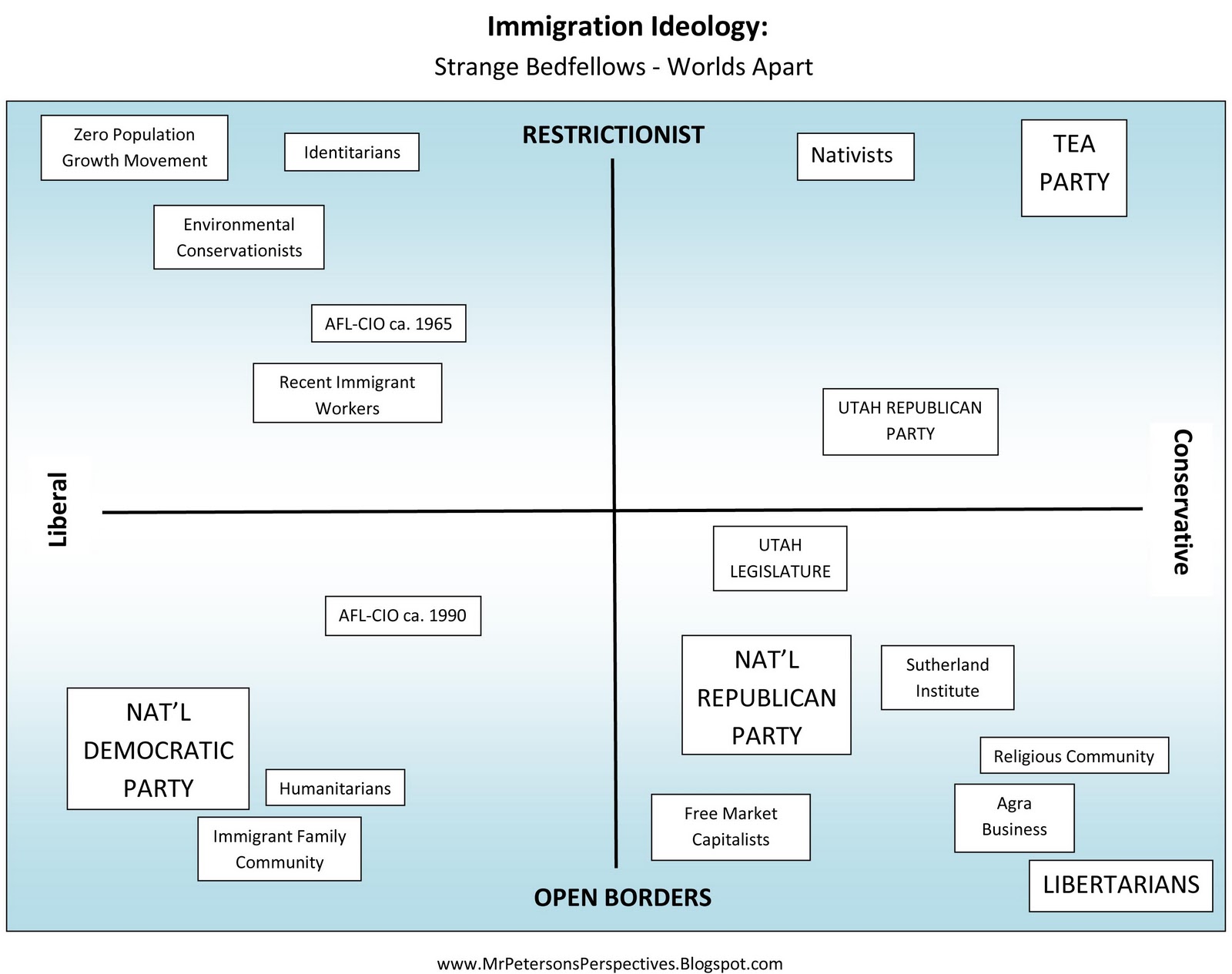
The left to right axis is the political ideological spectrum ranging from big-government-flaming-liberal on the left to small-government-tea-totaler on the right. The verticle axis represents views on immigration. At the top we have the restrictionist perspective which might reflect a view of limited immigration policy and/or a heavy enforcement preference in policy. The bottom of the spectrum would be dominated by a laissez faire policy view with more open borders.
This chart is by no means scientific but I tried to place the parties and institutions where I felt they belonged on the grid. Despite it's imperfections, I think it illustrates the point. The liberal-conservative axis almost becomes meaningless when applied to the immigration issue. Recent immigrants oppose new immigrants coming and competing for their jobs; liberal humanitarian groups and conservative religious organizations support allowing people the freedom to free themselves from tyranny in their homelands by coming to America; the Tea Party supports the stern rule of law while the Republican Party tries to balance the interests of business and the economy. It would seem that politics doesn't get any more interesting and rancorous than this.
However, it doesn't necessarily have to be that way in our discourse. I am always a big advocate for civil debate on the issues. Even emotionally charged issues deserve level headed discussion to help create reasonable solutions to policy questions. This civility is best practiced in our own personal lives. So, the next time you engage someone in a debate on this or any heated issue, think about their perspective and try to understand their argument before you engage in advocating for your position. You will be surprised at how much more respect that person will have for you and your point of view...even if you disagree in the end.
Wednesday, June 15, 2011
Utah Immigration: Like A Day At Lagoon
Imagine this scenario:
You are at Lagoon with your family and, even though your children are teenagers, you are told by park management that you and your family can only ride on Bulgy the Whale.

Then, someone on the ride says that they had heard that there are lots of open seats on the Colossus. You ask around and discover that it is common knowledge that there are open seats. You leave Bulgy the Whale and travel across the park to Colossus.

When you get there you discover there is a line of people from Bulgy the Whale, Tilt-a-Whirl, and a few other inferior rides stretching for a hundred yards waiting for their turn. Then you notice a curious thing. While there are ten empty seats available on Colossus, the attendant only lets one person on at a time while leaving nine of the seats empty. Meanwhile, there is a sign posted that says:
Another thing that you notice is that, rather than waiting in line, many of the folks are jumping the fence and seating themselves in the empty seats. Often, in the confusion, this means that more are climbing over than there are available seats. The attendant seems to shrug off this violation of the rules yet continues to dutifully administer his gate keeping responsibility with the folks still in line.
You hear someone in line talking about this situation and discover that park management has no intention of enforcing its line jumping rule. Yet, bafflingly, it also does not want to reduce the amount of seats available or increase the allowance of passengers to promote order and safety either!
Then you notice the Colossus' mechanics at work with welding torches cutting into the fence and creating another gate. The mechanics are tired of cleaning up messes created by the disorderly way people have been climbing on the ride. They are also upset with park management for making the ride unsafe and worse for wear. They have taken a vote and decided to create another gate so that the ride is full but not overflowing. The new gate will cut down on people line jumping while bringing order to a chaotic situation.
While this is going on you can hear a few original riders on Colossus yelling loudly: "Hey, you can't do that! That's against park management policy! Only park management can make new gates! And get all these Bulgy the Whale people off our ride!"
And thus, you see the mechanics reviled by the riders - the same mechanics who know the strengths and weaknesses of the ride and expend their efforts in correcting a problem so they can protect and preserve the very same ride in which they serve as caretakers.
On Saturday, June 18th, the majority of quiet voices in the Utah GOP will have a chance to be heard. May we hope that reason prevails and the loud and angry voices give way to those of sound judgment. Let us reject the resolution to repeal HB 116.
UPDATE: You can find a lightly edited version of this at the Standard Examiner website HERE.
You are at Lagoon with your family and, even though your children are teenagers, you are told by park management that you and your family can only ride on Bulgy the Whale.

Then, someone on the ride says that they had heard that there are lots of open seats on the Colossus. You ask around and discover that it is common knowledge that there are open seats. You leave Bulgy the Whale and travel across the park to Colossus.

When you get there you discover there is a line of people from Bulgy the Whale, Tilt-a-Whirl, and a few other inferior rides stretching for a hundred yards waiting for their turn. Then you notice a curious thing. While there are ten empty seats available on Colossus, the attendant only lets one person on at a time while leaving nine of the seats empty. Meanwhile, there is a sign posted that says:
"Line Jumping will not be tolerated and may be cause for ejection from the park."
Another thing that you notice is that, rather than waiting in line, many of the folks are jumping the fence and seating themselves in the empty seats. Often, in the confusion, this means that more are climbing over than there are available seats. The attendant seems to shrug off this violation of the rules yet continues to dutifully administer his gate keeping responsibility with the folks still in line.
You hear someone in line talking about this situation and discover that park management has no intention of enforcing its line jumping rule. Yet, bafflingly, it also does not want to reduce the amount of seats available or increase the allowance of passengers to promote order and safety either!
Then you notice the Colossus' mechanics at work with welding torches cutting into the fence and creating another gate. The mechanics are tired of cleaning up messes created by the disorderly way people have been climbing on the ride. They are also upset with park management for making the ride unsafe and worse for wear. They have taken a vote and decided to create another gate so that the ride is full but not overflowing. The new gate will cut down on people line jumping while bringing order to a chaotic situation.
While this is going on you can hear a few original riders on Colossus yelling loudly: "Hey, you can't do that! That's against park management policy! Only park management can make new gates! And get all these Bulgy the Whale people off our ride!"
And thus, you see the mechanics reviled by the riders - the same mechanics who know the strengths and weaknesses of the ride and expend their efforts in correcting a problem so they can protect and preserve the very same ride in which they serve as caretakers.
On Saturday, June 18th, the majority of quiet voices in the Utah GOP will have a chance to be heard. May we hope that reason prevails and the loud and angry voices give way to those of sound judgment. Let us reject the resolution to repeal HB 116.
UPDATE: You can find a lightly edited version of this at the Standard Examiner website HERE.
Thursday, March 3, 2011
General Session 2011: Days 37 and 38

The Hill is buzzing with anticipation as time runs out on the clock and legislation is being presented for passage or failure on the debate floor.
On Wednesday we held our final Political Subdivisions Committee meeting. The most noteworthy bill was SB 243 which puts a moratorium on Historic Landmark Designations in Salt Lake City. The Yalecrest ("Yell"crest) neighborhood erupted into a Hatfield and McCoy dispute recently over how the city was preparing to make the neighborhood a historic district. The neighborhood showed up to committee and gave passionate testimony on both sides of the issue. After voting the bill down on Monday, we received new information which prompted us to reconsider it on Wednesday where it passed out of committee with a favorable recommendation.
Wednesday also saw the ignominious death of HB70 - The Heavy Enforcement So-Called Arizona-Style Bill. Despite the bill being nurtured in weeks previous, the Senate Judiciary committee struck down the bill as "polarizing". You can listen to the Senate's brief comments on the bill HERE. The interesting side-story is that the Senate asked the bill sponsor to water down the wording in HB70 one more time and then put those words in a new bill with a new name. The senate has agreed to pass the new bill in its final compliant form.
At the same committee I was able to present HB48 - the Juvenile Fingerprints bill - for their consideration. You can listen to the audio presentation HERE. It was approved and will be heard on the Senate Floor.

Today we had a visitor. Shawn Bradley paid a visit to our Chamber. I am told that he once played a professional sport of some kind.
Finally, the House passed a GRAMA bill that makes common sense changes to the way the press access records of elected officials. Current law allows them to request personal records and exchanges. The changes in the bill will limit them to legislative business only.
The end game is in place for our immigration bill SB 60. The new "Omnibus" Immigration Bill SB 288 is due to be debated tomorrow. SB 60 is sitting safely "circled" on the Senate board and is ready to be pushed forward at any time. The bill was debated on the Senate Floor briefly today. You can watch the video and get a feel for where the Senate is going with immigration HERE. We will find out the fate of our bill likely tomorrow. Stay tuned for that.
Thursday, January 20, 2011
Potporri: Presession Update
I visited the Capitol yesterday for several meetings. Here are some tidbits that you might find interesting:
1. No Patrick Henry "Litmus Test" - The Patrick Henry Caucus, which I am a member of, voted to change it's bylaws which required its members to vote 90% of the time with the caucus position. Obviously, this provision seemed heavy handed to many legislators and therefore it has been removed.
2. Rep. Frank Fried - The Republican caucus voted in a majority to redraw Rep. Frank's boundaries when session commences last week. The only problem is that law requires a supermajority of 50 votes to get it done. Based on the vote count in the meeting, this seems very unlikely. It was apparent in the meeting that the personal politics involved here hindering an affirmative vote. It appears Rep. Frank's last recourse is the courts.
3. Expect Cuts - Our appropriations subcommittee received recommendations from the Office of Legislative Research on where to cut programs that we oversee by 10%. The staff said that the departments heads offered no suggestions as to where to make cuts so they arbitrarily chose places they thought were best. I am sure this will make our discussions with the various department heads quite lively.
4. Immigration Debate - The immigration debate is about ready to get it's kickoff with a broad variety of opinions and sentiments. Look for interesting news on this issue.
There will be more coming soon....
Monday, December 13, 2010
Day at the Capitol: Up Coming Issues
I spent the day at the Capitol with my legislative colleagues and fleshed out some of the issues that will be addressed during the Legislative Session starting in January. Here are some interesting points we discussed and some things you can look forward to:
$313 Millions Budget Deficit - The state budget still has a revenue shortage of $313 million that needs to be addressed. Under current tax rates, we will need to cut another 7% from the budget. Look for more difficult belt tightening.
Immigration - We were presented with the 8th revision of a much anticipated immigration bill. Apparently, the bill has been made bullet proof to constitutional challenges.
No New Taxes - We voted as a Republican Caucus today to not raise taxes this year to meet the budget deficit. This is good news for everyone. Instead, look for more paired down state programs this year.
Federalism Issues - The issues surrounding Federalism seem to be gaining traction on the Hill. One legislator is investigating the possibility of Federal Tax Escrow accounts while another is proposing reawakening the Constitutional Defense Council.
Deferred Building Maintenance - To trim the budget and live within our means, the legislature has taken money from funds used to maintain buildings. We have deferred this maintenance for several years now and we were warned that this can only happen a couple more years. We will be forced to increase the maintenance budgets again or otherwise risk more extensive damage to state owned buildings.
Rejection of Governor Herbert's Tax Acceleration - Governor Herbert's budget called for one time acceleration of tax revenue collection by mandating that businesses pay state taxes quarterly rather than yearly. This accounting "gimmick" would add about $110 Million to this year's budget by pulling revenues from the future. It's a one time fix and also would add an additional $10 Million in collection burden to the business community. We saw that as an undue tax increase and committed to not support that measure.
Saturday, October 9, 2010
Issues of Importance - Response to Reader
I recently received an email from Joyce Wilson:
Thank for the email Joyce. Before diving into Mr. Hansen's proposals, let me first highlight several issues that need to be addressed:
1. Illegal Immigration
I have written extensively on this. Please click here to see my proposed solutions.
2. Eliminating the Tax on Food
This is an issue that I have not had the opportunity to write about. Yet, I feel that it is important, especially for our district, to have the sales tax on food eliminated. The tax on food is a regressive tax (meaning those who make less pay more as a percentage of their income) and that fact impacts our district more so than most other districts in Utah. We were working to eliminate the tax on food up until 2008 when the economic crunch forced the legislature to reinstate the full tax. It is my belief that with the revenue projections stabilizing, we should begin down that road to eliminate the food tax once again. It is something that should be done gradually, say over a period of 6 years, but nevertheless it is something that should be done. My thoughts on this subject are heavily influenced by Adam Smith's opinion on the topic:
The question regarding this issue that I often get asked is: Where will the money come from to pay for this tax break? Keep in mind that I do not have the benefit of a legislative research staff at my disposal. But, my hunch based on my own observations is that there is a lot of waste and fraud in our state welfare system. This would be the first place I would look to balance the equation. Also, economically speaking, we may be able to grow our way into the tax break over a 6 year period as well. I am open to ideas that work and make sense.
3. Economic Growth
Obviously, the issue that affects us all in Ogden is jobs and the job market. We need more jobs. More importantly, Ogden needs an advocate at the state level that can present Ogden in the best possible light and accurately represent all the opportunity that Ogden possesses for businesses who want to grow. I do not have any legislative ideas to do this. However, as the sole breadwinner in my home and being self employed for the past 11 years, I understand businesses and what it takes to profitably operate one. Earning my marketing degree from Weber State University has been a blessing to my business and I know that those same skills can benefit District 9 when I apply those as Ogden's representative.
Now on to Mr. Hansen's proposals.
Note: According to the state site, none of these bills sponsored by Representative Hansen have become law.
2010 - Click to see list of bills and link to actual text and last action.
HB0156 Regulation of Laser Centers
HB0245 Voter Challenge Amendments
HB0297 Compact Agreement among the States to Elect the President by National Popular Vote
HB0322 Property Tax Valuation Amendments
HB0358 Voting by Mail
HB0436 State Officers' Salary Amendments
HJR008 Joint Rules Resolution on the Selection of Ethics Committee Members
The State Officers Salary bill was interesting because it called for a reduction in executive branch salaries. Yet, Mr. Hansen voted against several bills calling for Legislative pay reductions. Quite interesting.
2009 - Click to see list of bills and link to actual text and last action.
HB0049 Voter Challenge Amendments
HB0049S01 Voter Challenge Amendments
HB0158 Motorcycle Helmet Law Amendments
HB0166 Election Law Reforms
HB0175 Professional Licensing Amendments
HB0196 Provisional Ballot Amendments for Unregistered Voters
HB0200 Designation of Certain State Buildings
HB0217 Utah Indoor Clean Air Act Amendments
HB0227 Prohibition on Citation Quotas
HB0282 Task Force on Legislative Reform
HB0311 Utah State Railroad Museum Authority
HB0311S01 Utah State Railroad Museum Authority
HB0363 Property Tax - Determining Value for Tax Assessment
HB0367 Legislative Compensation Amendments
HB0406 Compact Agreement among the States to Elect the President by National Popular Vote
HJR026 Joint Rules Resolution on the Selection of Ethics Committee Members
I am grateful the property tax valuation bill did not pass. It would have allowed for a value assessment every time the property sold. On the surface, this seems like a fairly benign proposition but unfortunately it is this type of legislation that has opened the door to transfer taxes that have stymied affordable housing in other states.
There is quite a bit to digest here. Thanks for reading and taking time to learn about the issues. If you have any questions for me, send me an email or post a comment.
Enjoy your weekend!
Jeremy - back to the real issue of worthwhile legislation. I am sure you probably have researched this, so to save my time, do you have examples of the types of proposals Mr. Hansen has tried to bring to the committees or legislature? On rare occasion we will read items in the Standard-Examiner of some of his proposals but as I wrote, it is rare.
Scenario - you are now the Leg 9 representative - what are some bills you would craft to bring to committee (or however the process works)?
Joyce Wilson
Thank for the email Joyce. Before diving into Mr. Hansen's proposals, let me first highlight several issues that need to be addressed:
1. Illegal Immigration
I have written extensively on this. Please click here to see my proposed solutions.
2. Eliminating the Tax on Food
This is an issue that I have not had the opportunity to write about. Yet, I feel that it is important, especially for our district, to have the sales tax on food eliminated. The tax on food is a regressive tax (meaning those who make less pay more as a percentage of their income) and that fact impacts our district more so than most other districts in Utah. We were working to eliminate the tax on food up until 2008 when the economic crunch forced the legislature to reinstate the full tax. It is my belief that with the revenue projections stabilizing, we should begin down that road to eliminate the food tax once again. It is something that should be done gradually, say over a period of 6 years, but nevertheless it is something that should be done. My thoughts on this subject are heavily influenced by Adam Smith's opinion on the topic:
"The middling and superior ranks of the people, if they understood their own interest ought always to oppose all taxes upon the necessities of life, as well as all direct taxes upon the wages of labor." - The Wealth of NationsI won't address the tax on wages issue but the logic behind his statement is that the cost of everything we buy is driven by the cost of labor to produce those items. In turn, the cost of labor is driven by the cost of the necessities of life that are required to sustain those laborers. Therefore, when taxes on food are eliminated and the cost of food decreases, the working class is able to better support themselves at a lesser cost. A portion of that savings translates into wage savings for producers and therefore cheaper goods for the populace at large. Everyone gets more for less under his theory. Intuitively, I agree with this.
The question regarding this issue that I often get asked is: Where will the money come from to pay for this tax break? Keep in mind that I do not have the benefit of a legislative research staff at my disposal. But, my hunch based on my own observations is that there is a lot of waste and fraud in our state welfare system. This would be the first place I would look to balance the equation. Also, economically speaking, we may be able to grow our way into the tax break over a 6 year period as well. I am open to ideas that work and make sense.
3. Economic Growth
Obviously, the issue that affects us all in Ogden is jobs and the job market. We need more jobs. More importantly, Ogden needs an advocate at the state level that can present Ogden in the best possible light and accurately represent all the opportunity that Ogden possesses for businesses who want to grow. I do not have any legislative ideas to do this. However, as the sole breadwinner in my home and being self employed for the past 11 years, I understand businesses and what it takes to profitably operate one. Earning my marketing degree from Weber State University has been a blessing to my business and I know that those same skills can benefit District 9 when I apply those as Ogden's representative.
Now on to Mr. Hansen's proposals.
Note: According to the state site, none of these bills sponsored by Representative Hansen have become law.
2010 - Click to see list of bills and link to actual text and last action.
HB0156 Regulation of Laser Centers
HB0245 Voter Challenge Amendments
HB0297 Compact Agreement among the States to Elect the President by National Popular Vote
HB0322 Property Tax Valuation Amendments
HB0358 Voting by Mail
HB0436 State Officers' Salary Amendments
HJR008 Joint Rules Resolution on the Selection of Ethics Committee Members
The State Officers Salary bill was interesting because it called for a reduction in executive branch salaries. Yet, Mr. Hansen voted against several bills calling for Legislative pay reductions. Quite interesting.
2009 - Click to see list of bills and link to actual text and last action.
HB0049 Voter Challenge Amendments
HB0049S01 Voter Challenge Amendments
HB0158 Motorcycle Helmet Law Amendments
HB0166 Election Law Reforms
HB0175 Professional Licensing Amendments
HB0196 Provisional Ballot Amendments for Unregistered Voters
HB0200 Designation of Certain State Buildings
HB0217 Utah Indoor Clean Air Act Amendments
HB0227 Prohibition on Citation Quotas
HB0282 Task Force on Legislative Reform
HB0311 Utah State Railroad Museum Authority
HB0311S01 Utah State Railroad Museum Authority
HB0363 Property Tax - Determining Value for Tax Assessment
HB0367 Legislative Compensation Amendments
HB0406 Compact Agreement among the States to Elect the President by National Popular Vote
HJR026 Joint Rules Resolution on the Selection of Ethics Committee Members
I am grateful the property tax valuation bill did not pass. It would have allowed for a value assessment every time the property sold. On the surface, this seems like a fairly benign proposition but unfortunately it is this type of legislation that has opened the door to transfer taxes that have stymied affordable housing in other states.
There is quite a bit to digest here. Thanks for reading and taking time to learn about the issues. If you have any questions for me, send me an email or post a comment.
Enjoy your weekend!
Monday, July 12, 2010
Illegal Immigration: Reasonable Solutions
I have had the opportunity to ponder somewhat on the illegal immigration issue over the past couple of weeks. While visiting with folks in the district it appears that illegal immigration is going to be a big (if not the biggest) issue on voters minds this election season. With that in mind, I thought that now would be an appropriate time to articulate my views on immigration and what we can do as a state to deal with it.
THE PROBLEMS
First, throughout the history of the United States, we have had immigration to our country. Sometimes,and often, those immigrants came in such large numbers that assimilation was slow. Our founding fathers wondered if the immigrants would ever abandon their native tongues and traditions to assimilate and become full-blooded Americans. Benjamin Franklin expressed this very concern about the large number of inhabitants in Pennsylvania clinging to their German heritage. Ultimately, Pennsylvania assimilated, although over the course of several generations.
The reasons for people coming to America are many. Economic, social, and political forces abroad have made the freedom and opportunity of America an attraction to the world. Our way of life is coveted by many people of the world and they desire to come here to take advantage of what our nation has to offer.
Nevertheless, throughout the history of the Unites States, we have exercised control over the number of people that have come here. We have also had in place standards that dictate the quality of individuals seeking to immigrate. In the past, Ellis Island served as a clearinghouse for new immigrants coming across the Atlantic. Those with diseases, extremely unskilled laborers, or those deemed likely to be a burden on society were turned away at Ellis Island and sent home.
Today our immigration is processed by foreign embassies. We make exceptions for refugees and other people seeking political asylum.
Unlike the past where our immigration was primarily from mainland Europe and the British Isles the bulk of immigration today is disproportionately from nations across our southern border. The Senora Desert is an obstacle to those trying to come here but it is not as great a barrier as the Atlantic Ocean once was. Additionally, unlike the past, our process for allowing for legal immigration is now entirely unfit for the purpose. However, the desire to come here has not diminished but rather, to America’s credit, it has at the very least remained constant or even increased. Hence, our Southern border today leaks like a sieve and people come and go almost at will and unaccounted for.
The majority, I believe, of these individuals come seeking a better life for themselves with the goal of working to earn for their families.
Another layer of complication in this issue is the Federal ambivalence to enforcing its own existing laws on immigration. Although the complexity of state's rights vs. federal prerogative has not been fully explored, it is clear that the Federal government has delegated authority over immigration:
“The Congress shall have Power…To establish an uniform Rule of Naturalization” Article 1, Section 8 of the US Constitution.
Just the same as the Utah Supreme Court does not have jurisdiction over or the power to enforce Arkansas State law, the State of Utah cannot have jurisdiction over or by some unknown right enforce Federal Law. Federal Law is enforced by the Federal Government. State Law by the state government. As a Constitutional conservative, I believe in upholding and sustaining our constitution and that we must work within our Federal structure to bring about a true and lasting solution to our broken immigration system.
With that said, Utah can be a leader in the very type of reform we need to see happen at the Federal level. Therefore, I believe Utah should find its own equitable solution in the absence of Federal enforcement. Interestingly, we may see this debate unfold soon as Arizona now faces down the Department of Justice on this very issue of states rights.
THE SOLUTIONS
So what can Utah do to support our local economy, live by the spirit of Liberty pronounced in our founding documents, and also reduce the burden that undocumented workers place on our society?
Within the federal system we live, we must encourage Utah’s representatives in Congress to propose and pass the kind of reform that is right. Utah can also build a coalition of States as State Legislatures, Governors, and those respective state’s federal delegations work towards the type of truly American reform we are so badly in need of.
As broken as our immigration system is, the Arizona approach to immigration reform appears to be unconstitutional. It is also extremely shortsighted in that it may portend the future doom of conservative values as a majority voice in politics a generation from now as our demographics change. We would have been wiser had we never allowed ourselves to come to this crossroads.
Being the party of Liberty and Republican ideals, we should be sponsoring immigration reform that:
1. Encourages the free flow of labor for the benefit of Americans and American business.
2. Allows all to come to America who are healthy, employable, productive, and not criminally minded.
3. Welcomes immigrants into our way of life.
How do we do that?
First, this coalition of states would recommend the revision of the existing quota system as it is outdated and counterproductive to the free flow of labor. The new quota system would be based on demand for foreign laborers and what our society could reasonably absorb. Quotas would be balanced between those wanting to become citizens vs. those wanting to work here only temporarily. Citizens tend to take ownership in our society while temporary workers do not.
Second, the coalition would support the creation of a new version of an Ellis Island at the main ports of entry at the Southern border. This would have significant symbolic meaning and also provide a "go to" place for individuals wanting to immigrate to the country. Individuals immigrating here must be employable, be free from disease, prove that they will not be a burden to society, and have a sponsor.
Third, this coalition would support a new Federal program for verifying that employees are documented workers. Immigration is generally not an issue for the FBI, ATF or the CIA. A new division just for ensuring compliance with immigration law would need to be created but would be an important part of protecting our population from criminals and possible terrorists. With this, I would support strict penalties for those hiring undocumented individuals as well as penalties for those undocumented workers. This is an important element currently missing in our existing law.
Fourth, we would remove all special incentives provided to immigrants such as out-of-state tuition waivers. As someone who paid out of state tuition here, I find this practice a misuse of public funds.
Fifth, those immigrants who choose not to adhere to these laws (which would accommodate the legal status of more of the immigrant community than current law) would be subject to deportation or confinement.
The purpose of these ideas would be to allow labor to travel more legitimately that it currently does while also requiring immigrants to take financial responsibility for themselves.
By creating a process for people to come here legally and through main ports of entry, it would all but eliminate the flow of illegal immigrants through our open borders. It would also allow the border to be patrolled to find those who really are dangerous, criminally minded and/or terrorists.
It is also my hope that we can strike a balance between justice that must be served and the mercy that we extend to those who come here. Perhaps by increasing justice and mercy simultaneously, we can meet the needs of our economy, unburden our schools and hospitals, and provide a way for those seeking life, liberty, and the pursuit of happiness as those generations who have gone before us..
Thursday, June 10, 2010
The Immigration Dilemma

With Arizona's new law taking affect next month and now Utah's elected officials talking about enacting a similar law, I thought it would be timely to articulate my position on illegal immigration.
I believe that illegal immigration is an issue about fairness. Lets talk about a few of the issues that make illegal immigration unfair:
Depressed Wages
It is unfair to legal immigrants who come here to work to have to compete with an unlimited supply of illegal immigrants for work and wages. Economics 101 tells us that supply and demand dictate price. When supply increases and demand remains the same, prices go down. This is what immigrants of all varieties are experiencing due to the massive influx of undocumented workers. They are competing for their livelihoods and depressing wages.
Increased Medical Expenses
Many, if not most, illegal immigrants do not carry a personal health insurance policy nor do they have the cash to pay for services up front. Our hospitals typically will not deny emergency services to anyone who is uninsured or poor. Thus, the cost for caring for the uninsured is unfairly placed on the shoulders of the hospital and insurance companies who pass that expense along to its policy holders or paying users...you and I.
Fractured Community Schooling
There is a movement among schools to make the school a hub of the community. You find in many suburban settings that this works well as people will often spend decades in a neighborhood to raise their children and send those kids to one school. This tends to build cohesion between teachers and parents and builds a partnership that is in the best interest of the children. In contrast, the illegal immigrant population is very mobile. In Ogden City schools, student mobility is 30% annually! This movement disturbs the partnerships that take time to create between parents and teachers. This mobility is often traumatizing to a student's education and brings test scores down accordingly. Thus, the school system (and ultimately society at large) is unfairly burdened by the frequent movements of those in the illegal immigrant community.
Entitlement Graft
Unfortunately, many illegal immigrants ask for and receive welfare assistance from Utah taxpayers. Food stamps, in-state tuition, and other assistance provided by the taxpayers of Utah are an unfair burden and an irresponsible use of public funds when distributed to illegal immigrants.
~~~~
So here we have illustrated just a few of the issues that are negatively affecting our state. The next question is how to we solve this problem?
It seems to me that the immigration issue is mostly a pocketbook issue for those coming here. They want to work and therefore they go where work is to be had. The pay is better than their home countries and those working can afford to send a large portion of their paycheck home to family out of the country. In fact, money transfers from the U.S. to Mexico is the 2nd largest revenue generator for Mexico's national income! Oil production is 1st by the way. That shows the huge impact that this immigration inflow is having and the huge incentives that countries like Mexico have to export their working poor to our communities. My proposal to solve this problem would be to mandate checks on proof of citizenship at all money wire facilities. This would accomplish two things:
1. It would keep the money earned here by illegal immigrants in the local economy.
2. Those seeking employment for the purpose of exporting their income abroad will have a huge disincentive to move to Utah.
I also would advocate the end of welfare benefits for non-citizen residents. These two ideas, in my opinion, remove the incentives for illegal immigrants to move here. Given such, the immigrants will ultimately "self deport" to their native lands and save the taxpayer the burden of paying for expensive law enforcement initiatives. It also is less controversial than "rounding people up" and jailing them prior to deportation. I believe that by removing the incentives, the problem will solve itself.
Immigration is a very complicated issue and this post just touches on a few caveats of the dilemma. I will post more later as the debate unfolds this election season.
Subscribe to:
Posts (Atom)