The 2012 Legislative Session continues to move forward.
Mr. Peterson's Bills
HB22 and HB23 passed the House Floor and Senate Committees. They will be heard on the Senate Floor and then move to the Governor's office for a signature.
SB129 and SB37 are on their way from the Senate to the House and I will be making presenations on the House Floor shortly.
My 6-Month Car Registration Bill (HB133) will be submitted to the House Rules Committee very soon.
Two more bills are still at Legislative Research waiting for numbering and will hopefully be ready very soon. One deals with an Unemployment Insurance exception for Head Start programs, and the other deals with creating a cross reference in the code to provide for better application of zoning enforcement.
Floortime
I had the opportunity to sponsor the yearly Revisor's Bill (SB104) in the House this year. You can watch my presentation on the floor HERE.
Box Elder Gone Bananas
Finally, Box Elder County GOP held its yearly Lincoln Day Dinner. A rogue candidate for U.S. Congress running against Rob Bishop had the opportunity speak to the audience. You can watch his interesting presentation, made in a wacky tie-die skirt, below:
I think this is a case of someone taking too much of something, or not enough of something else. Whew!
Thursday, February 2, 2012
Monday, January 30, 2012
Salvation: Engineers and City Solve Seismic Woes
The squeaky wheel gets the grease.
When I began working with the Baptist Church at 25th and Jefferson to find a solution to their seismic woes, the way forward was not entirely clear. Our proposed HB58 was adamantly opposed by the Structural Engineers Association of Utah and area building inspectors. The Legislature was interested in this issue but was sharply divided on which policy decision was best.
Fortunately, despite our disagreements on HB58, we all could agree that we still needed to find a solution that worked for the Baptist Church.
The circumstances of the Baptist Church don't fit neatly into the box created by statute to deal with seismic upgrades. Thus, my involvement to try to change the state statute. Although my proposal was a principled approach, it was described as "trying to nail a wall tack with a sledge hammer." Regardless, my ultimate goal was to provide some relief to my constituents. This is why I am excited to see the SEAU and Ogden City step up to the challenge and craft a unique answer to this perplexing problem.
After reviewing the matter, the SEAU has agreed to provide pro bono services to the Church to allow for a seismic survey and determine what needs to be done to help upgrade the property. This service is a significant savings to the church who would otherwise have been forced to fork out thousands of dollars for the review. The best part is that Ogden City has agreed to issue a permit to have the roof completed without siesmic upgrades happening first. In exchange, the Church will agree to put an "incremental" plan in place where they will agree to make upgrades as funding becomes available.
This solution gets to the rub of my argument at committe: seismic upgrades are an economic issue. If re-roofing forces people to make upgrades, it can bankrupt them due to the cost. Rather than go bankrupt, people will neglect making repairs to the roof and risk damage to their building. Essentially, the current law is an unfunded personal mandate. However, providing for an incremental plan addresses the affordability problem. It allows for upgrades to be made as funds become available to do so. This is a win-win for all involved.
I would like to thank Steve Patrick at Ogden City, Chris Kimball with Kimball Engineering, and Barry Welliver with the SEAU for forging a way forward that is both palatable and common-sensed. The Baptist Church and the community at large appreciate their efforts.
Friday, January 27, 2012
Moving Forward: Lessons From The First Week of Session 2012
Growing Pains
This week has been quite the learning experience. Like anyone learning to ride a bike, the first step is to learn to stay up and moving. Once you get comfortable and aren't tipping over all the time, you can start to do more adventurous things.
This week's adventurous activity was being the only Freshman to have bills to present on the first day of presentations. These bills were heard during interim session several months ago and were approved UNANIMOUSLY by our committee at that time. A couple weeks ago I got a call from a colleague who asked if he could take HB30 and run it through the Senate with some minor alterations. I agreed since I thought it would be a good opportunity to work with a seasoned Senator and learn from his experience. That left me with HB22 and HB23 to present on the House Floor. These bills were seemingly simple and very straight forward...or so I thought.
The State has a new video archive system. You can watch my initial presentation HERE. (Be sure to click on the HB22 link in the scroll box below the player.) Unfortunately, I had some problems. First, my laptop battery died with my notes on it just as I got up to present. Second, I had no written notes. Third, I had not spent enough time reviewing the material and I had difficulty with mental translation. The summary I received from the Department of Workforce Services (DWS), who requested the legislation, was longer than the bill itself and written in a cryptic dialect of Bureaucratese. Here is the summary:
If you watch the video you can see the bill fail as the voting board runs red with "No" Votes. The title of the bill wasn't helpful either. Many of my colleagues expressed their distaste with the bill title. It might as well have read: Federal Mandate Database Act. Clearly, the Federalist spirit is alive and well in our legislative body.
To make the day even more interesting, I had to present HB23 immediately after that. You can use the same link to find that presentation. Fortunately, it went moderately better and the bill passed.
When HB22 failed, a colleague told me that he would bring the bill back for reconsideration if I could get some more information on the implications of the bill. I met with DWS at 9:30am the following morning to inquire as to its benefits and advantages. To my surprise there were many more than were initially provided.
You can watch video of my second presentation at 10:00 AM HERE. (Be sure to click on HB22 again). The bill passed. It is not very often that a failed bill gets a second opportunity at life. I am grateful the body gave me the opportunity to make the case. This whole experience was a valuable lesson in both preparation and proper presentation.
Honorable Mentions
After that drama was over, I got word that the Unemployment Insurance bill my colleague in the Senate was running would be mentioned by Governor Herbert in his State of the State address. Sure enough, my name was mentioned as a sponsor. You can see that clip below:
That was a nice gesture and I am sure it will help the prospects for SB 129. I already have many of my colleagues wanting to co-sponsor the bill.
Thumb Screws 101
Another interesting experience I had this week was watching some of my colleagues take an interest in an issue I took up in HB58. When HB58 failed in committee on Monday, I thought the issue was dead and I would move on. Not so. One of my colleagues was in negotiations with the parties who opposed my bill while dealing with a bill of his own. However, unlike my bill, my colleague was working as their advocate in his bill. Nevertheless, as their advocate, my colleague expressed his extreme displeasure with their treatment of my bill and began negotiating the introduction of its provisions into the bill he was writing. The dynamics of the negotiation were captivating to watch. I am unsure if they have concluded so I will have more information on the results of the wrestling match next week.
Tuesday, January 24, 2012
H.B. 58 SPIKED: Status Quo Steeple Statute
Those of you who have followed the blog are aware of my efforts to change state law regarding the construction code to allow for more free market mechanisms to operate when it comes to seismic upgrades. My effort on this issue stems from constituent complaints originated back in October. This statute change was embodied in my proposed H.B. 58.
The first day of session was hectic as I tried to prepare a substitute bill. I had negotiated a compromise with members of the Structural Engineers Association of Utah. Unfortunately, I worked up the draft only to learn at the last minute that those I had negotiated with reneged on their proposed compromise. Members of my committee were also uncomfortable with some of the compromise provisions. Since we appeared to be making no one happy, we scrapped the compromise and pushed for the original wording of the bill. I invited the caretaker of the church to testify in committee today. In opposition, the Structural Engineers Association of Utah showed up in force. The conversation was contentious at times and it finally came to a vote.
Our proposal failed: 5-7. A couple of my colleagues surprised me with their vote. Interestingly, after interviewing the folks who I felt were on the fence, it became apparent that our cause would fail even if we amended the bill and tried to bring it back for reconsideration.
I am now trying to put together some Ogden area stakeholders to see if there are some other means available to help the Baptist Congregation fix their roof and seismically upgrade their property. Hopefully we can find a coalition of folks here locally who would be willing and able to help preserve this beautiful landmark and worship center.
Monday, January 23, 2012
The Thomas Paine Common Sense Caucus
A group of of my colleagues on the Hill have made headway to form a new caucus on the Hill. We are calling it the Thomas Paine Common Sense Caucus. It's origins stem from the desire to have ample information on bills and also provide insight on their impact to the State on several different levels.
Today, when a bill is created, a fiscal note is attached to the bill and it shows the impact that the bill will have on state government revenue and expenses, local government revenue and expenses, and personal and business revenue and expenses. One of the main thrusts of the caucus is to expand that scope to understand more than just the monetary impact. The exact formula is still being honed but the caucus wants to have research done that produces "Impact Notes" showing the effect on family status, small businesses, and other socio-economic perspectives. The caucus has hired an auxiliary intern to assist with research.
I have joined the caucus as have many of my colleagues. Look for more news on this front as the caucus matures and starts producing interesting data on various bills.
Here's to Common Sense!
Thursday, January 19, 2012
Equality Utah: Boiling the Frog In the Pot
Yesterday afternoon I was at Capitol Hill meeting with stakeholders regarding one of my bills. While I was there, I bumped into a few of my colleagues to discuss some of the upcoming issues.
One of my Republican colleagues revealed he would be co-sponsoring a bill with a Senate Democrat. That doesn't seem so outrageous to me, I did that last year. But, the subject matter of his bill I thought was unusual. It appears that this year the same-sex attraction community is pushing for an anti-discriminatory bill to protect those in the LGBT community from eviction or firing from employment based on sexual orientation. The bill has not been released yet for review but it should be soon. Supposedly, it will mirror several statutes that already exist in several municipalities. I don't doubt that.
Personally, I feel that this bill will codify what is already the everyday practice of the marketplace and society. I don't oppose the bill's provisions because I don't think it is going to change anything about how people go about their business.
But, this raises another question. Why even run this bill? Is it a solution looking for a problem to solve? On the surface it appears to be. But when one takes a step back and examines the dynamics of LGBT issues and politics, it materializes that this bill is just one arrow in the quiver of same-sex attraction political strategy.
When I came home, I was greeted on my dining table by this packet that arrived in the mail from Equality Utah:
Equality Utah: Dan Jones Survey Results 1-19-12
The questionnaire lays the groundwork for the debate with an obvious bias by the survey sponsor, Equality Utah, in favor of the anti-discriminatory bill and other issues. The survey shows overwhelming support for an anti-discriminatory law. I think this reflects my perception. Everyone thinks it's the law already because that is how people already behave.
Also, to put further support behind this bill and others that are sure to follow, the survey asks if Utah is perceived as being fair and respectful of gay and transgendered folks. What is interesting about this is that it does not ask if Utah is fair and respectful but asks if other people think it is perceived as such. So the question is like me asking: What do you think your sister thinks about you? Not: What do you think of yourself. Interesting way to ask the question. Anyway, the majority say we don't think others perceive us well. Is this just more of the usual Utah-peculiar-people-self-conciousness? I bet that this score would be high regardless of the subject matter. You could ask: Do you think outsiders think Utahn's are strange? Of course we think they do. Perhaps we should keep that in mind while interpreting these survey results.
I will let you review the rest of the survey. But one thing is certain, expect to see more legislation to push forward the agenda of the gay and lesbian community. Clearly, encouraged by these survey results, the LGBT community feels that now is the time to strike to push their own agenda forward. For instance, today's Salt Lake Tribune reports about an openly gay Democratic colleague of mine who is pushing for insurance benefits for cohabitating adults of any sexual orientation. I am not especially excited about this particular measure.
Of course, the ultimate prize is to somehow conquer public opinion and legalize same-sex marriages at the Federal level. Like any experienced Cajun chef knows, you don't throw a frog in a boiling pot. Frogs are best cooked slowly and warmed to boiling degree by degree. For the LGBT community, that is done one state and one statute at a time.
Monday, January 16, 2012
Strange Bedfellows: Immigration's Unlikely Alliances
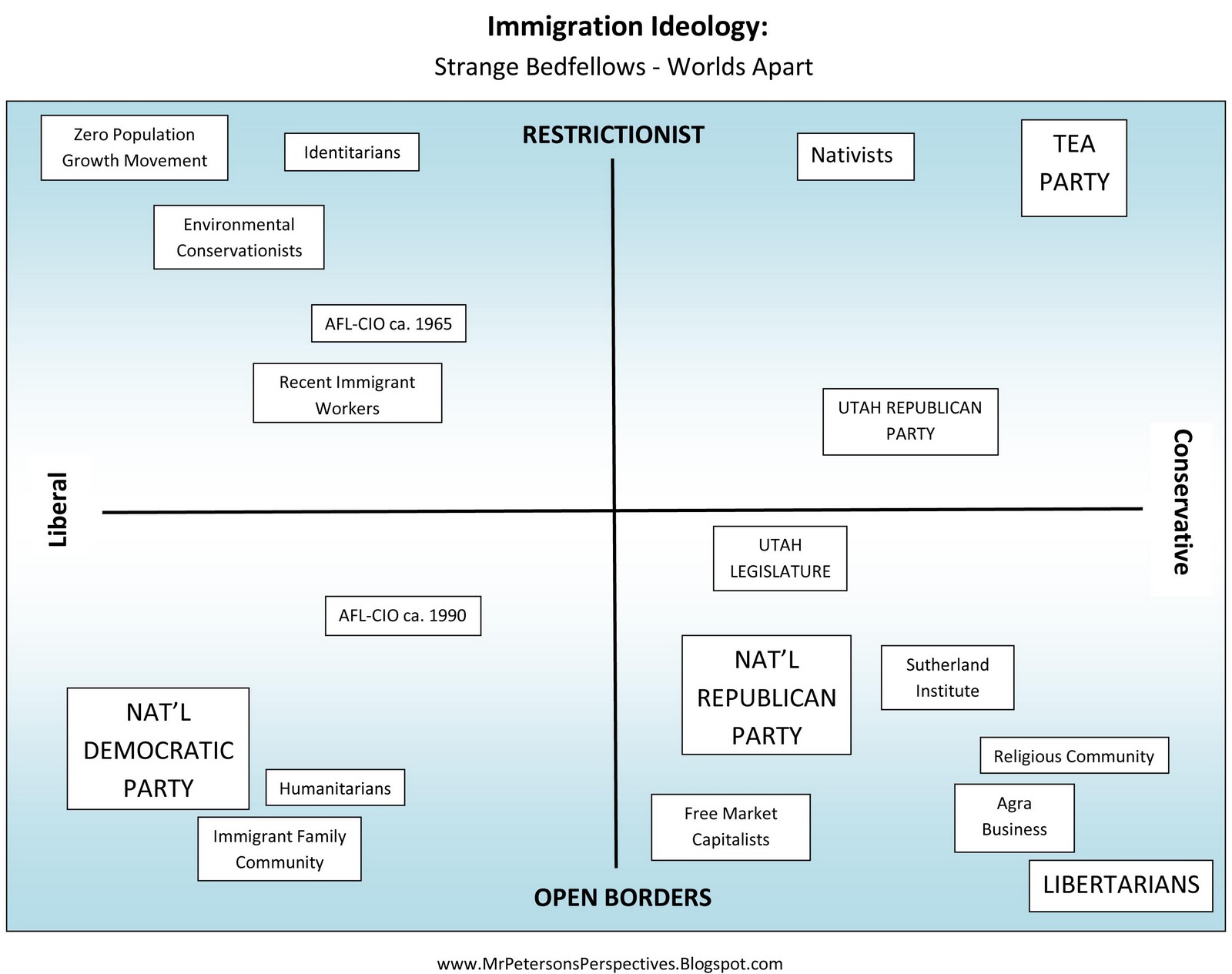
What has been made most clear to me during this last year debating and studying the immigration issue, is that this issue, more so than any other, makes for the strangest political bedfellows one could imagine. To help illustrate my point, I created this chart (click to enlarge):
The left to right axis is the political ideological spectrum ranging from big-government-flaming-liberal on the left to small-government-tea-totaler on the right. The verticle axis represents views on immigration. At the top we have the restrictionist perspective which might reflect a view of limited immigration policy and/or a heavy enforcement preference in policy. The bottom of the spectrum would be dominated by a laissez faire policy view with more open borders.
This chart is by no means scientific but I tried to place the parties and institutions where I felt they belonged on the grid. Despite it's imperfections, I think it illustrates the point. The liberal-conservative axis almost becomes meaningless when applied to the immigration issue. Recent immigrants oppose new immigrants coming and competing for their jobs; liberal humanitarian groups and conservative religious organizations support allowing people the freedom to free themselves from tyranny in their homelands by coming to America; the Tea Party supports the stern rule of law while the Republican Party tries to balance the interests of business and the economy. It would seem that politics doesn't get any more interesting and rancorous than this.
However, it doesn't necessarily have to be that way in our discourse. I am always a big advocate for civil debate on the issues. Even emotionally charged issues deserve level headed discussion to help create reasonable solutions to policy questions. This civility is best practiced in our own personal lives. So, the next time you engage someone in a debate on this or any heated issue, think about their perspective and try to understand their argument before you engage in advocating for your position. You will be surprised at how much more respect that person will have for you and your point of view...even if you disagree in the end.
Subscribe to:
Posts (Atom)